
Why More Indian Homeowners Are Switching to Solar Energy in 2026?
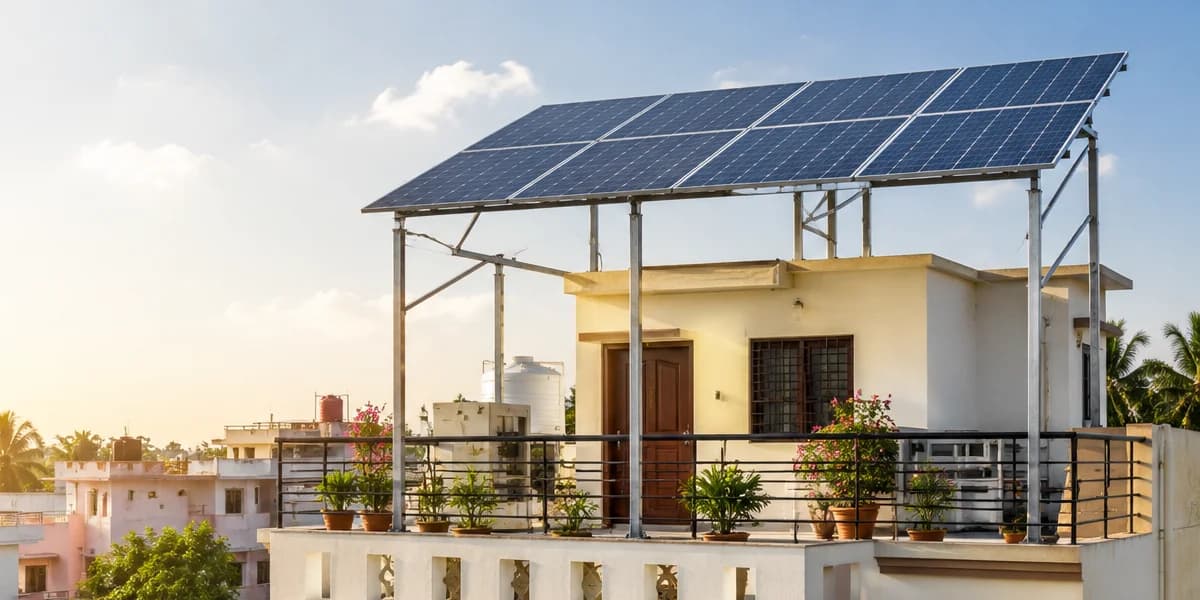
Walk through any residential colony in Pune, Ahmedabad, or Indore today, and you will notice something that would have looked unusual just five years ago — rooftop after rooftop fitted with solar panels. What was once considered a niche investment for environmentally conscious homeowners has quietly become one of the most practical financial decisions an Indian household can make in 2026.
This shift did not happen overnight. It is the result of rising electricity bills, government subsidies that finally make sense on paper, falling equipment costs, and a growing awareness that solar is no longer a "someday" upgrade — it is a "why didn't I do this sooner" decision. Let's understand exactly what is driving this change, and how you, as a homeowner, can be part of it.
The ₹4,000 Question Every Household Is Asking
Picture a typical middle-class home in a Tier-2 Indian city. The family pays somewhere around ₹4,000 to ₹6,000 a month in electricity bills, and that number only seems to go up every summer. A few years ago, the response to a rising bill was simple: switch off a few lights, use the AC a little less, maybe complain about it at the next family gathering. In 2026, more and more households are asking a different question entirely — instead of consuming less electricity, why not generate their own?
That single mental shift, from "how do I cut usage" to "how do I produce my own power," is at the heart of why solar adoption is exploding across the country right now. It's no longer a trend confined to environmentally minded early adopters. It's showing up in ordinary neighborhoods, among ordinary families, for the most ordinary reason of all — saving money every single month.
The Numbers Tell a Clear Story
India's rooftop solar sector has seen genuinely explosive growth this year. Installations jumped 125% year-on-year in the first quarter of 2026, driven largely by residential demand, pushing the country's total rooftop solar capacity past 23 GW. Maharashtra, Uttar Pradesh, and Gujarat currently lead the pack, but smaller cities and towns are quickly catching up.
More tellingly, over 4 million Indian households have already gone solar, and the average family adopting rooftop solar is seeing their electricity bills drop by roughly 71%. Over the 25-year lifespan of a typical system, that translates to savings north of ₹3 lakh per household. For a country where electricity bills are a recurring monthly stress point, that is not a small number — it is life-changing for many families.
Rising Electricity Costs Are the Real Trigger
Ask any homeowner why they finally decided to install solar panels, and the answer usually starts with the same complaint: the electricity bill keeps climbing every year, no matter how careful they are with usage. Grid tariffs across most Indian states have been rising steadily, and with summers getting hotter and air conditioning use increasing, monthly bills have become harder to predict and control.
Solar energy solves this problem at its root. Instead of paying a utility company for every unit consumed, a home with rooftop solar generates its own electricity during the day, cutting dependence on the grid significantly. A typical 3–5 kW residential solar system now pays for itself in just 4 to 5 years, after which the homeowner enjoys decades of electricity that costs next to nothing beyond basic maintenance. In a country where fixed monthly expenses only seem to grow, this kind of long-term cost certainty is genuinely rare — and it's exactly why solar has stopped being viewed as a luxury and started being viewed as a smart financial hedge.
Government Support Has Removed the Biggest Barrier
For years, the single biggest reason Indian families avoided solar was the upfront cost. Installing a residential rooftop system used to require an investment of ₹2 lakh to ₹5 lakh, which was simply out of reach for most middle-class households, even if the long-term savings made sense.
The launch of the PM Surya Ghar: Muft Bijli Yojana changed that equation. Under this scheme, the central government now offers subsidies of around 40% for systems up to 3 kW, and 20% for systems between 3 kW and 10 kW, directly reducing the amount a household needs to pay out of pocket. The scheme has already been applied for by nearly 7 million households, and more than 4 million homes have been fully solarised as a result.
Beyond the subsidy itself, the process of applying has also become far simpler. A national online portal now allows homeowners to apply, get approvals, and receive subsidy payments directly into their bank account, cutting through paperwork that used to discourage people before they even got started. State electricity boards have also sped up net-metering approvals in many regions, meaning homeowners don't have to wait months just to get their system connected to the grid.
Solar Technology Has Genuinely Improved
It's not just the financing that has changed — the equipment itself is simply better than it was even three or four years ago. Newer solar panels are more efficient at converting sunlight into electricity, which means homeowners can generate more power from the same amount of rooftop space. This is particularly useful in Indian cities, where rooftop space is often limited and shared between water tanks, satellite dishes, and drying clothes.
Battery storage technology has also improved and become more affordable, giving households the option to store excess solar power generated during the day and use it in the evening or during a power cut — a genuinely useful feature in areas that still experience occasional grid instability. Smart monitoring systems now let homeowners track exactly how much electricity their system is generating and consuming, right from a mobile app, taking the guesswork out of managing a solar setup.
Solar Is Becoming a Real Estate Advantage
Here's something most people don't consider until they've already gone solar: a home with a rooftop solar system installed is genuinely more attractive on the resale and rental market. In many Tier-2 and Tier-3 cities, solar-equipped homes are commanding noticeably higher resale and rental value compared to similar homes without one. Buyers and tenants increasingly see a solar setup the same way they see a modular kitchen or a covered parking spot — a practical upgrade that saves them money from day one, not just an environmental statement.
For homeowners thinking long-term, this means solar isn't only an investment in lower electricity bills. It's also an investment in the resale value of the property itself.
Energy Independence Matters More Than Ever
Beyond the financial argument, there's a growing sense among Indian homeowners that generating your own electricity is simply a smarter way to live. On 21 May 2026, India recorded an all-time peak electricity demand of 270.7 GW, and solar power — including rooftop solar — helped meet about 22% of that demand. This shows that rooftop solar isn't just benefiting individual households anymore; it is genuinely helping stabilise the national grid during periods of extreme stress.
For a homeowner, this translates into a very practical benefit: less reliance on a grid that can occasionally be unpredictable, especially during heatwaves or heavy monsoon disruptions. Producing your own power, even partially, offers a sense of security that a monthly electricity bill simply cannot.
Busting the Myths That Still Hold People Back
Even with all this momentum, plenty of homeowners hesitate because of old assumptions that no longer hold true. It's worth clearing a few of these up.
"Solar only works in sunny states like Rajasthan or Gujarat." This used to carry some truth, but modern panels are efficient enough to generate meaningful power even in cities with moderate sunlight, including parts of North and East India that see cloudier winters. What matters more than your state is your roof's orientation and shading, which any decent installer will assess before quoting you.
"It's too expensive for a regular household." This was true before PMSGY. Today, with subsidies covering a significant chunk of the cost and financing options widely available through banks and NBFCs, the upfront burden has dropped considerably, and most families recover their investment well within five years.
"The paperwork and approvals take forever." This was a legitimate complaint two or three years ago. With the national portal streamlining applications and several states automating feasibility approvals for smaller systems, what once took months now often takes a matter of weeks.
"Solar panels need constant maintenance." In reality, rooftop solar systems require very little upkeep — mainly occasional cleaning to remove dust, and an annual check-up. There are no moving parts to wear out, which is part of why panels typically come with 25-year performance warranties.
The Real Solution: How to Actually Get Started
If you've read this far, chances are the numbers have already convinced you that solar makes sense. The good part is that going solar in 2026 is far simpler than most people assume. The process typically involves four straightforward steps.
First, get a rooftop assessment done by a certified installer to understand how much sunlight your roof receives and what system size suits your electricity consumption. Most homes in India only need a 3 to 5 kW system to meet their daily needs comfortably.
Second, apply through the national PM Surya Ghar portal to check your subsidy eligibility and register your installation — this step alone is responsible for making solar accessible to millions of households that previously couldn't afford it.
Third, choose a reliable, empanelled installer rather than the cheapest quote you can find; installation quality has a direct impact on how much electricity your system generates over its lifetime.
Finally, once installed, apply for net metering with your local electricity board so that any surplus power your system generates can be sent back to the grid in exchange for bill credits.
The entire journey, from application to a fully functioning rooftop system, typically takes a few weeks in most Indian states today, a dramatic improvement from the months-long delays homeowners used to face just a couple of years ago.
A Word of Honest Caution
Solar adoption in India isn't entirely without friction, and it's worth being upfront about that. Even with strong demand, the national conversion ratio from application to actual installation under PM Surya Ghar has hovered around 23%, largely due to gaps in awareness, financing confusion, and inconsistent installer quality in some regions. States like Gujarat and Kerala, which have mature solar ecosystems and strong vendor networks, see conversion ratios above 65%, proving that the right guidance and a trustworthy installer make all the difference between a smooth installation and a frustrating one.
The takeaway here isn't that solar has hidden problems — it's that doing a little homework before choosing an installer, and understanding the subsidy process clearly, goes a long way in avoiding unnecessary delays.
Quick Questions Homeowners Often Ask
How much does a residential solar system cost after subsidy? A 3 kW system, enough for a typical small home, generally costs a fraction of its original price once the 40% central subsidy is applied, and several state governments add further incentives on top of that.
Will solar work during a power cut? A standard grid-connected system without a battery will not, since it's designed to sync with the grid. Adding battery storage solves this and lets you keep essential appliances running during an outage.
How long do solar panels actually last? Most quality panels are built to perform reliably for 25 years or more, with only a gradual, minor dip in efficiency over that time.
Is net metering available everywhere in India? Availability and rules vary by state and electricity board, so it's worth checking with your local DISCOM before finalizing your system size, since this affects how much you can earn or save from surplus power.
Final Thoughts
Indians are switching to solar energy in 2026 for refreshingly practical reasons: lower electricity bills, generous government subsidies, better and more reliable technology, higher property value, and a genuine sense of energy security in an unpredictable climate. What used to be a decision driven mainly by environmental concern has become a decision driven by simple household economics — and that shift is exactly why adoption is accelerating so quickly.
If you've been putting off the switch to solar, 2026 might genuinely be the most sensible year to stop waiting. Between the subsidy support, the shorter payback periods, and the improved technology available today, the case for rooftop solar has never been stronger for the average Indian homeowner.

Sakshi is a dedicated and versatile content writer with over four years of experience in creating clear, engaging, and well-researched content across multiple industries. Skilled in news writing, Tenders, Solar and technology topics, web content, blogs, articles, newsletters, and niche areas like pet and food content. She brings a balanced mix of creativity and accuracy to every project. Known for turning complex information into easy, reader-friendly writing, she focuses strongly on audience needs and meaningful storytelling. Her approach helps brands communicate confidently and deliver content that truly connects with readers.